
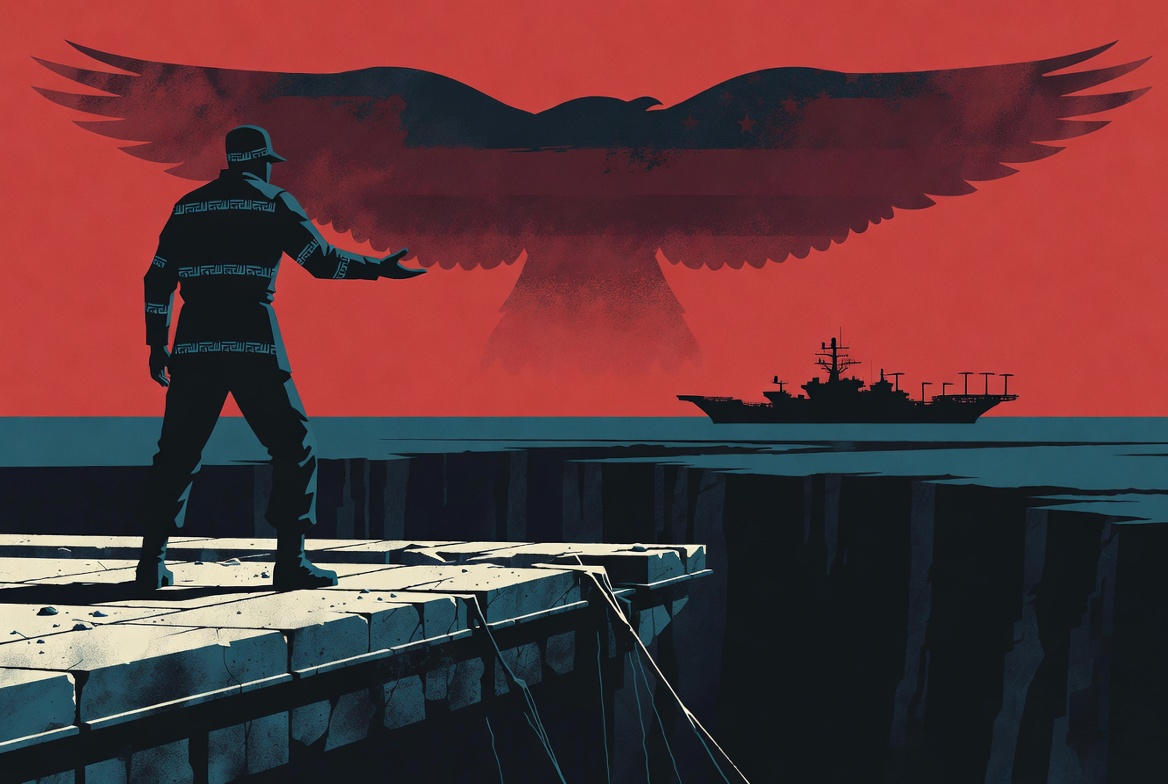
The Iranian regime has spent years violating agreements and understandings with the United States in unusually loud and theatrical ways. It has advanced its nuclear program far beyond previous limits, supported attacks on American forces through proxies, and launched direct strikes on Israel and regional American targets. These moves have often come at clear cost to the regime itself. The pattern suggests something deeper than ordinary brinkmanship or simple miscalculation.
The regime behaves this way because its core ideology treats direct confrontation with the United States as meaningful rather than purely destructive. At the same time, internal divisions and practical limits have kept this impulse from producing outright self-destruction. Understanding both sides of this dynamic is essential for any realistic approach to Iran.
The ideological engine
The Islamic Republic is not a conventional nation-state that weighs costs and benefits in purely material terms. It is a revolutionary project built on Twelver Shia doctrine. Central to this worldview is the belief in the eventual return of the twelfth imam, the Mahdi, and the idea that current struggles form part of a larger divine process. Within this framework, resistance against the United States, described as the Great Satan, carries spiritual weight.
Martyrdom holds a privileged place in the regime’s rhetoric and self-image. Dying while confronting perceived enemies of Islam is presented not as defeat but as victory and a step toward hastening the Mahdi’s appearance. This does not mean every official wants the state to collapse tomorrow. It does mean the ideology lowers the perceived cost of high-risk confrontation and raises the perceived value of visible defiance.
When leaders speak of preferring honorable death to shameful life, they are not engaging in empty posturing. They operate inside a system that has long framed survival through accommodation as a form of betrayal. This creates a consistent pull toward provocative actions even when those actions invite stronger responses from a far more powerful adversary.
Evidence in action
The style of Iran’s violations often stands out. Rather than quiet cheating on agreements, the regime has frequently chosen public, maximalist moves. Nuclear enrichment has proceeded in open defiance of international limits and warnings. Attacks through proxies have been sustained even as sanctions tightened. Direct missile and drone operations against Israel and American positions have been carried out with public claims of responsibility.
These choices fit an ideological logic that benefits from visible resistance more than from quiet survival. The regime gains internal legitimacy and maintains its revolutionary identity by refusing to back down in ways that would look like submission. Over time this pattern has contributed to a cycle in which provocations increase the likelihood of serious pushback from the United States and its partners.
The brakes that still exist
The ideological current does not operate without resistance inside the system. Factional divisions have existed for more than a decade and became especially visible after the death of Supreme Leader Ali Khamenei in February 2026. Power struggles between harder-line elements and more institutionally cautious voices have created moments of restraint even during major crises.
Material limits have also mattered. Iran’s inventory of advanced long-range missiles is finite. After years of sanctions and earlier exchanges, the regime has sometimes been forced to rely more on drones and shorter-range systems when responding to strikes. This has shaped the scale and targets of retaliation rather than allowing unlimited escalation.
Hardliner control of communications and the internet adds another layer. By dominating the information environment, harder-line factions can amplify the resistance narrative and make arguments for restraint politically costly. This strengthens the ideological pull but does not eliminate all internal checks. After the February 2026 strikes that killed Khamenei, the regime launched significant retaliation yet moved toward a ceasefire and negotiations within months rather than pursuing total confrontation.
These brakes have prevented the regime from following its ideological impulses to their most extreme conclusion. They have not, however, removed the underlying pressure toward risky provocation.
What this means going forward
Any effective policy toward Iran must account for both the ideological driver and the real limits on its behavior. Purely diplomatic approaches that assume the regime will eventually prioritize economic relief over its core commitments have repeatedly failed. At the same time, strategies that treat the regime as a simple death cult ignore its demonstrated ability to absorb damage and reorganize.
The United States should maintain strong sanctions focused on the Revolutionary Guard, the nuclear program, and proxy networks. These measures raise the cost of continued aggression without broadly punishing the Iranian population. Credible military deterrence, including forward presence and rapid response options, remains necessary to make further escalation expensive for Tehran.
Support for the Iranian people should focus on tools that reduce the regime’s information monopoly. Expanded access to independent information and reliable internet connections can strengthen internal pressure over time. Any future diplomatic engagement must stay conditional on concrete, verifiable changes in behavior, especially regarding nuclear activities and support for armed groups.
It improves conditions for ordinary Iranians by weakening the regime’s tools of repression and foreign adventurism. Many inside Iran already recognize credible alternatives to the current system, which reduces the risk of sudden power vacuums. This approach avoids reckless interventions that could strengthen remaining hardline elements or create unnecessary regional disorder.
The regime that keeps daring America to strike is not on a simple path to self-destruction. It operates under an ideology that makes dangerous escalation appear useful and even honorable. Internal divisions and material realities have so far prevented the worst outcomes. Those same realities, however, have not removed the persistent pressure toward further provocation. Any successful strategy must recognize this tension rather than wish it away.
دستهها:English
 آخرین بهروز رسانی فرمانده سنتکام از اوضاع تنگه
  دَدیت کیه، هورموز؟
  Making A Point With President Trump
  Still Searching for Delsey in Tehran
  پیالهچی piyalechi.com
بیان دیدگاه